
On this page
Carmakers likely to raise prices again after festive season as HR steel costs jump 30% year on year
Our read
Carmakers, Maruti Suzuki included, will more likely than not raise prices again after the festive season, even as sales growth slows to 5-6%.
For operators
Carmakers have already raised prices 2-3 times this year and look likely to do so again after the festive season, with HR steel up 30% year on year in September, so dealers should plan for higher stock costs and slower demand as growth eases to 5-6% in October 2026–March 2027 against about 10% for the full fiscal.
Watch
HR steel inflation above September's 30% year on year in the October reading would mean a post-festive hike is near-certain and rivals will follow.
The report,
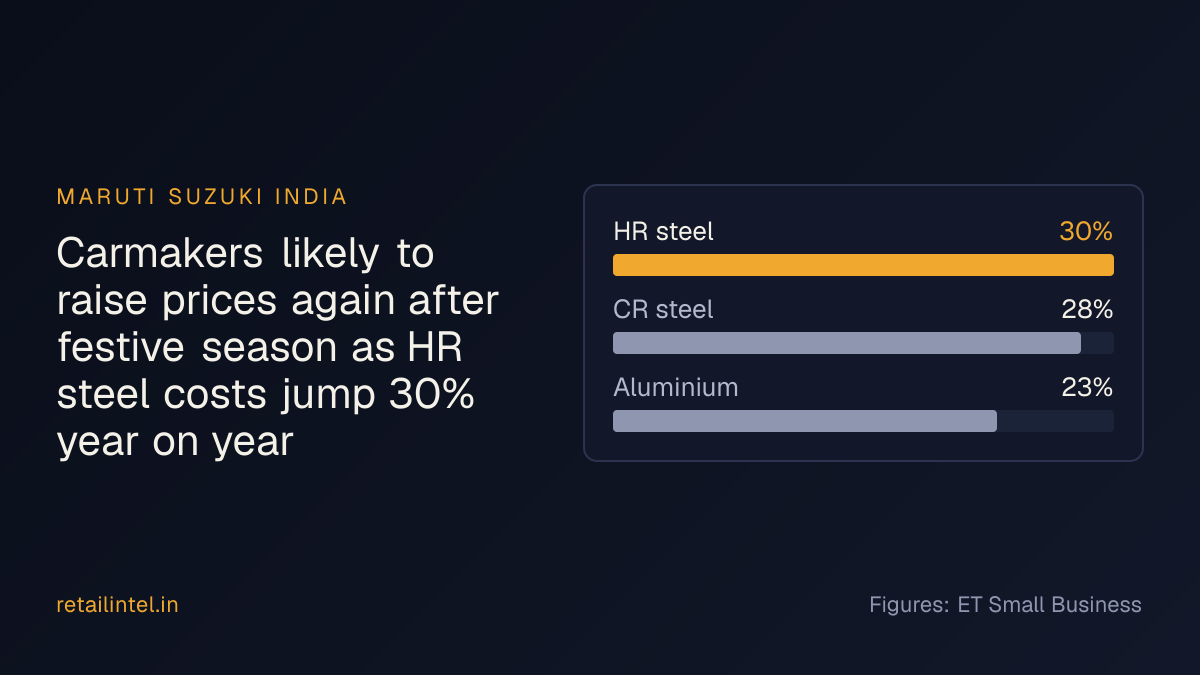
Carmakers have taken 2-3 price hike rounds this year, and HR steel prices rose 30% yoy in September, so more hikes may follow after the festive season. Car sales growth is seen moderating to 5-6% in October-March FY27.
- HR steel30%
- CR steel28%
- Aluminium23%
One email each morning: the day’s top moves in Indian retail, why each matters and what to watch. Free. Stop any time.
Reported figures
From the report. Source details below
| CR steel price rise, September yoy: | 28% |
|---|---|
| Aluminium price rise, September yoy: | 23% |
| Baltic Dry Index, September: | 3,408 points |
| Mercedes-Benz India price adjustments this year: | 1-2% |
| Expected total car sales growth this fiscal: | about 10% |
What to track next
- Price-increase notices from Maruti Suzuki or its rivals after the festive season
- Q3 FY27 results commentary on input-cost pressure and margins
- Baltic Dry Index moving away from 3,408 points
- Dealer inventory and booking trends once the festive season ends
Likely next moves
Our read of what comes next — analysis, not reported by the source.
- Maruti Suzuki is likely to hold list prices through the festive peak and then announce another increase across several models.
- Rival carmakers are likely to follow within weeks, since they face the same steel, aluminium and freight costs.
- Dealers may push year-end discounts and exchange offers to clear stock before any new price list takes effect.
- Buyers on the margin are likely to bring purchases forward into the festive season, which would make the post-festive slowdown steeper.
- Component suppliers are likely to press carmakers for cost pass-through as steel and aluminium stay well above last year's levels.
The counter-case
The case against this reading — not reported by the source.
The headline treats an input-cost spike as if it guarantees a price rise, and the deck's own numbers weaken that link. Sales growth is expected to slow from about 10% to 5-6%, which cuts carmakers' pricing power just when they would want to pass costs on. The 2-3 increases already taken this year may have recovered much of the cost pressure. Any further rise is likely to be small, variant-specific or deferred, and it can be offset by discounts, exchange bonuses and finance schemes, so effective transaction prices may barely move. The 30% HR steel figure is a year-on-year comparison. It may reflect a weak base and say little about the current month-on-month trend, and steel prices can ease quickly. The Baltic Dry Index at 3,408 points is a shipping-cost gauge and only loosely tied to what domestic carmakers pay for steel under negotiated contracts. 'Likely' also rests on unnamed expectations, not on any announced price list.
The source
Published
First seen