
On this page
Homegrown brands enter sub-Rs 20,000 smartphone segment as memory chip costs push Samsung, Oppo, Vivo, Xiaomi to cut exposure
Our read
Homegrown brands, Ai+ among them, will take sub-₹20,000 space the majors vacate, but memory costs will keep prices high and margins thin.
For operators
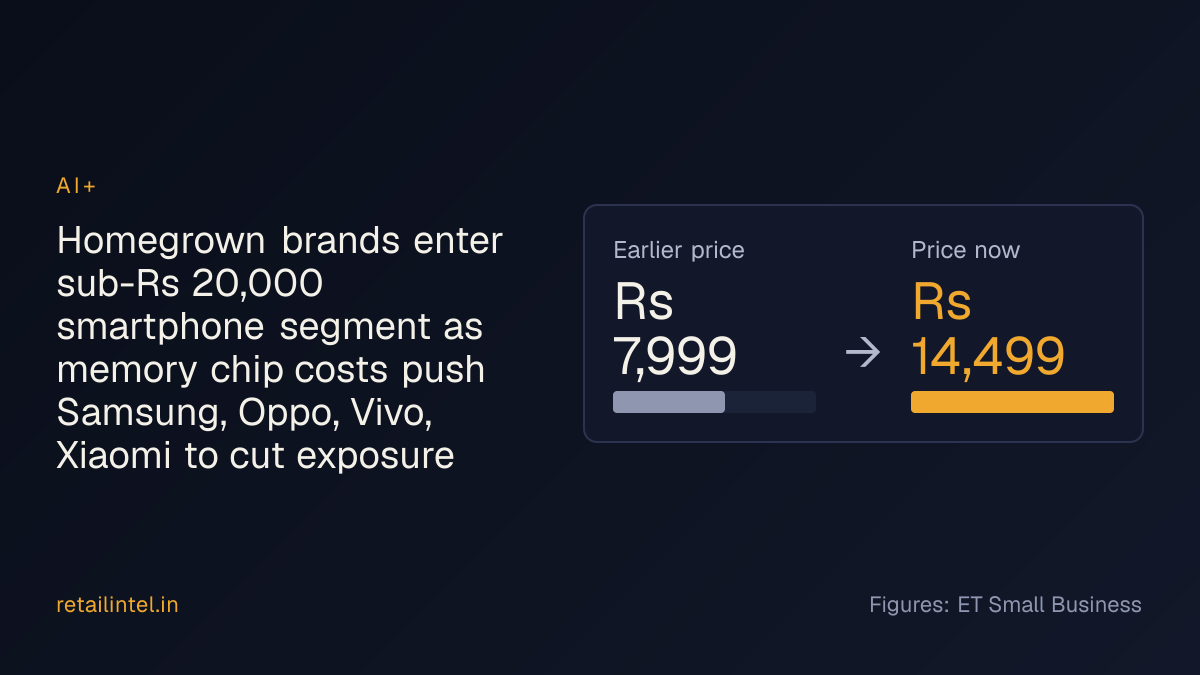
Memory is about 40% of a budget handset's bill of materials and Samsung, Oppo, Vivo and Xiaomi are cutting exposure, with Lava's entry 5G phone up from Rs 7,999 to Rs 14,499, so phone retailers should rework their sub-Rs 20,000 range and price ladders toward homegrown brands.
Watch
Lava's entry 5G price above ₹14,499 by the end of the festive season 2026 would mean memory costs are still passing through, leaving Ai+ little room to undercut.
The report,
Memory components can account for around 40% of a budget handset's bill of materials, and Ai+ and Lava have already seen early traction among cost-conscious buyers. Lava's entry-level 5G phone rose from Rs 7,999 to Rs 14,499.
One email each morning: the day’s top moves in Indian retail, why each matters and what to watch. Free. Stop any time.
Reported figures
From the report. Source details below
| Additional MPMS incentive for Indian design and R&D: | 3% |
|---|---|
| Entry segment share of consumers: | 80% |
What to track next
- Karbonn's relaunch happening within festive season 2026
- Samsung, Oppo, Vivo or Xiaomi launching or discontinuing sub-₹20,000 models
- MPMS incentive approvals or payouts for Indian brands
- Memory chip contract price direction in the next quarter
Likely next moves
Our read of what comes next — analysis, not reported by the source.
- Ai+ is likely to keep its sub-₹20,000 phones priced near the new post-memory-cost levels rather than the old ₹7,999-type entry points.
- Samsung, Oppo, Vivo and Xiaomi are likely to keep thinning their budget lineups and shift mix toward higher-margin models.
- Lava may hold or lift entry 5G prices again if memory costs do not ease.
- Indian brands including Ai+ are likely to apply for the MPMS incentive of 5% plus 3% for Indian design and R&D.
The counter-case
The case against this reading — not reported by the source.
The headline treats homegrown brands as beneficiaries of the memory squeeze, but the evidence in the signal points the other way. Lava's entry 5G phone rising from Rs 7,999 to Rs 14,499 shows Indian brands face the same input-cost shock. Small brands also have the weakest purchasing power: they buy memory on spot or short-term terms, while Samsung (itself a memory maker), Oppo, Vivo and Xiaomi have long-term supply agreements and priority allocation. Samsung, Oppo, Vivo and Xiaomi 'cutting exposure' is probably a temporary portfolio reshuffle toward higher-margin models, not an exit, and they can return once memory prices ease. Karbonn's relaunch is planned for festive season 2026, well beyond the current price cycle, so the opening may close before it arrives. The MPMS incentive of 5% plus 3% for Indian design and R&D is small against a cost line that makes up about 40% of the bill of materials and has moved sharply. Indian brands also have a weak record in this segment: Micromax, Lava and Karbonn lost share to Chinese rivals once scale and distribution mattered. A Rs 14,499 'entry' 5G phone sits above where many entry buyers are. The claim that the entry segment accounts for 80% of consumers makes the opening look larger than the price-sensitive volume that can actually be served at these prices.
The source
Published
First seen