On this page
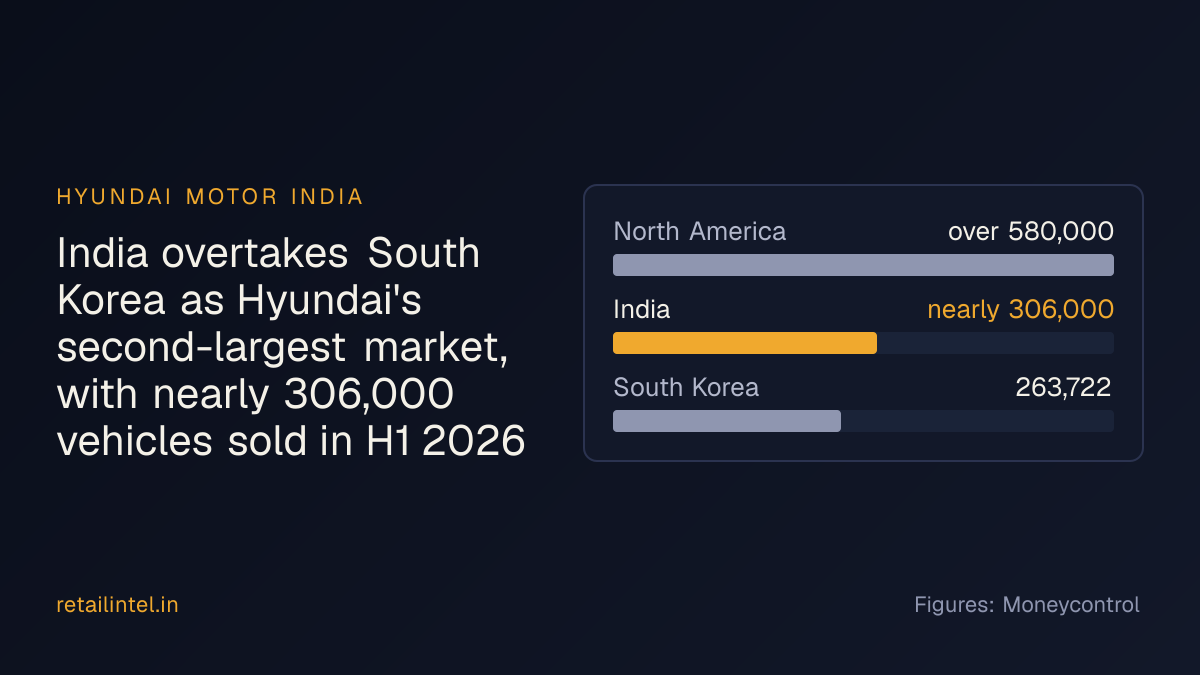
India overtakes South Korea as Hyundai's second-largest market, with nearly 306,000 vehicles sold in H1 2026
Our read
India will more likely than not stay Hyundai's second-largest market, with the gap over South Korea widening as Pune capacity and new launches come in.
For operators
Hyundai sold nearly 306,000 vehicles in India in H1 2026, up 7%, and is lifting Pune capacity to 320,000 units a year with 26 launches planned by 2029, so operators in the auto retail chain should expect rising volumes and a heavier product cycle.
Watch
India sales growth above the 7% reported for H1 2026, at the next quarterly results, would mean Pune capacity is being absorbed and rivals face a faster-scaling Hyundai.
Ask next
What else has Hyundai Motor India done in the last three months?The report
Hyundai Motor India's sales rose 7% year on year, while South Korea's fell 11% to 263,722 units, leaving only North America ahead. The company is investing Rs 4,000 crore to expand its Pune plant to 320,000 units a year.
- North Americaover 580,000
- Indianearly 306,000
- South Korea263,722
One email each morning: the day’s top moves in Indian retail, why each matters and what to watch. Free. Stop any time.
Reported figures
From the report. Source details below
| Hyundai North America H1 2026 sales: | over 580,000 |
|---|---|
| Planned India launches by 2029: | 26 |
Why it matters to operators and investors
Hyundai's Rs 4,000 crore Pune expansion to 320,000 units a year and 26 India launches by 2029 show a long-term commitment to India, which makes the local auto ecosystem of component, dealer and service businesses a more credible area to scout for partners.
What to watch next
- South Korea sales against the 263,722 units in H1, in the next half-year tally
- Timing of the first launches under the 26-launch plan to 2029
- Pune plant commissioning milestones against the ₹4,000 crore investment
- Rival carmakers' price cuts or launches in Hyundai's core segments
Likely next moves
Our read of what comes next — analysis, not reported by the source.
- Hyundai Motor India is likely to speed up its 26-launch pipeline to 2029, front-loading models in high-volume segments.
- Expect Hyundai Motor India to keep adding Pune capacity toward 320,000 units a year and to press suppliers on local sourcing and delivery.
- Rival Indian carmakers may answer with sharper pricing or faster launches in the segments Hyundai targets.
- Hyundai's global parent is likely to give India a larger share of product and investment planning as South Korea shrinks.
- Component suppliers and dealers around Pune are likely to add capacity and inventory to match Hyundai's volume plans.
The counter-case
The case against this reading — not reported by the source.
The headline treats a relative ranking as a structural milestone, but the ranking owes as much to Korea's weakness as to India's strength. Korea fell 11%, while India's 7% growth is modest for a market with a low base and a push into SUVs. If the Indian industry grew faster than 7% in the same period, Hyundai may have lost share while still passing Korea. The comparison is also volume only. Indian cars sell at far lower prices and, in general, thinner margins than Korean or North American ones. Being the number two market by units says little about profit, and arguably flatters the India story. The comparison may also mix definitions: Indian figures are typically dispatches to dealers, and Korean figures may be counted differently. A small gap in one half-year could reverse with a single model cycle or a stock correction. The Rs 4,000 crore Pune investment, 320,000 units of capacity and 26 launches by 2029 are plans rather than results. Capacity expansion ahead of demand, and a heavy launch cadence in a crowded segment against Maruti Suzuki, Tata and Mahindra, could weigh on utilisation and returns.
The source
First seen