On this page
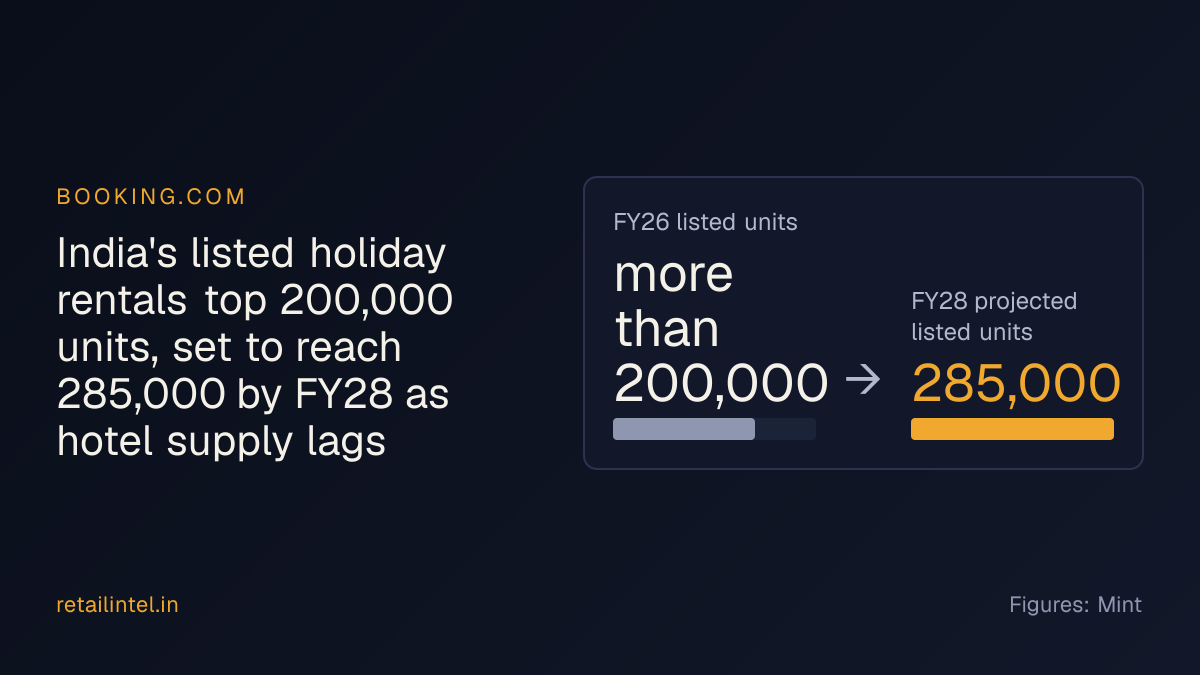
India's listed holiday rentals top 200,000 units, set to reach 285,000 by FY28 as hotel supply lags
Our read
With alternative-accommodation listings above 200,000 units (up 26% in FY26) and branded hotels at just over 213,000 rooms in February 2026, hotel operators now face holiday rentals as a near-equal supply competitor.
Watch
Listed units past the 285,000 projected for FY28, in the next Booking.com–Videc count, would mean rentals are outpacing hotels and rivals must chase hosts.
The report,
India had more than 200,000 digitally listed alternative-accommodation units in FY26, up 26%, and the segment will reach 285,000 by FY28, a Booking.com and Videc report said. Online holiday-rental bookings are projected to nearly double to ₹18,660 crore by FY29.
One email each morning: the day’s top moves in Indian retail, why each matters and what to watch. Free. Stop any time.
Reported figures
From the report. Source details below
| Online holiday-rental bookings in FY26: | ₹9,340 crore |
|---|---|
| Total holiday-rental market by FY29: | ₹41500 crore |
| Holiday-rental market annual growth rate: | 21.2% |
| Branded hotel rooms, February 2026: | more than 213,000 |
Why it matters to operators and investors
With listed units forecast to reach 285,000 by FY28 and hotel supply lagging, holiday-rental managers and aggregators become candidates for hotel chains short of rooms to partner with or acquire.
What to watch next
- Online rental bookings versus the ₹9,340 crore reported for FY26, in the next annual update
- Any state registration or licensing rule for holiday rentals and homestays
- Branded hotel room additions against the 213,000 rooms counted in February 2026
- Host commission or incentive changes announced by Booking.com or its main rivals
Likely next moves
Our read of what comes next — analysis, not reported by the source.
- Booking.com is likely to keep recruiting hosts, especially in leisure markets where hotel rooms are scarce, to widen its listed rental inventory.
- Rival platforms such as Airbnb and MakeMyTrip may respond with host incentives or lower commissions to defend their share of listings.
- Branded hotel chains may lean harder into leisure destinations and home-style or managed-villa formats to hold their share of stays.
- State tourism authorities are likely to move toward registration and safety norms for homestays and rentals as the segment gets bigger.
- Property owners and small operators are likely to list more units online as the booking-value forecast draws them in.
The counter-case
The case against this reading — not reported by the source.
The headline compares unlike things and leans on a partisan source. The report comes from Booking.com, which earns commission on these listings and benefits from a story of fast growth. 'Digitally listed units' measures how many properties were put on platforms, not how many are bookable, occupied or earning money. Listings can be duplicated across platforms, dormant, or onboarded through the platform's own sales push, so the 26% rise may reflect marketing effort more than real new supply. Setting 200,000+ units against 213,000+ branded hotel rooms is not like-for-like: a unit can be a multi-room villa or a single apartment, and a room is a room. The claim that 'hotel supply lags' is therefore framing, not a demonstrated shortfall. The projection that bookings nearly double from ₹9,340 crore to ₹18,660 crore by FY29 implies roughly 26% growth a year for three years. That is a straight-line extrapolation of recent momentum, and it ignores saturation, weaker demand, or tighter rules. Regulation is a real risk, including state registration norms, tax treatment, and resident association or local-authority pushback. The link to listed retail companies is also thin, since the main beneficiaries are private platforms and property owners.