
On this page
Nestlé India lifts Q2 FY27 ad spend 46% as FMCG peers raise marketing despite input-cost pressure
Our read
Nestlé India will more likely than not keep ad spend growing at an elevated rate, and faster-spending FMCG peers will keep the category's marketing intensity high through H2 FY27.
For operators
Nestlé India raised advertising and marketing spend 46% year-on-year in Q2 FY27, so retailers stocking its products have a brand putting more money into promotion this quarter.
Watch
Marico, Colgate-Palmolive India and Dabur Q2 ad spend growth against their Q1 rates
Ask next
How do Nestle India's results compare with its rivals?The report,
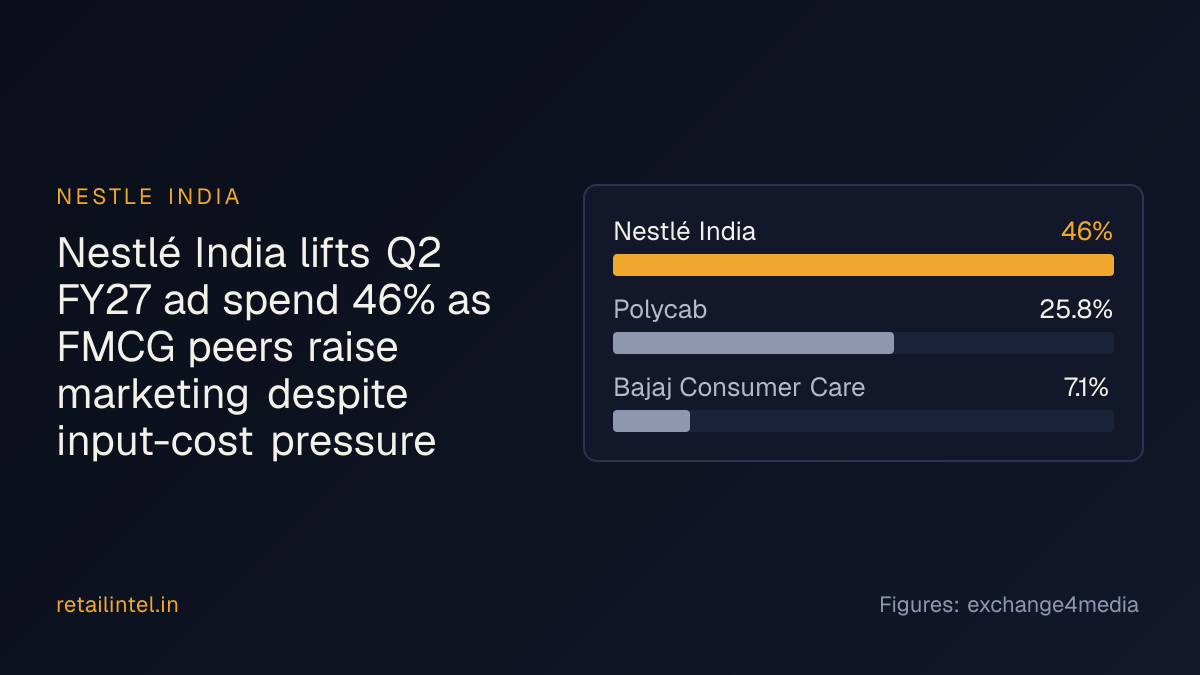
Nestlé India raised advertising and marketing spends 46% year-on-year in Q2 FY27, while Marico's Q1 ad spend rose 25% to ₹327 crore and Colgate-Palmolive India's rose 33.7% to ₹251.9 crore, despite rising input-cost pressure.
- Nestlé India46%
- Polycab25.8%
- Bajaj Consumer Care7.1%
One email each morning: the day’s top moves in Indian retail, why each matters and what to watch. Free. Stop any time.
Reported figures
From the report. Source details below
| Dabur Q1 FY27 ad spend growth: | 13.6% |
|---|
What to track next
- Nestlé India ad spend growth below the 46% reported for Q2 FY27, in the Q3 FY27 results, would mean the step-up was a one-off and rivals need not match it.
- Nestlé India's Q3 FY27 margin commentary on input costs versus marketing
- HUL's next ad spend growth against its 3.7% in Q1
- Management remarks on ad budgets for the second half of FY27
The counter-case
The case against this reading — not reported by the source.
The headline treats one 46% jump as an industry trend, and the evidence doesn't support that. Nestlé India's figure is for Q2 FY27, while the Marico, Colgate-Palmolive India, Dabur and HUL figures are for Q1, so the peer set is not like-for-like. Several peers are weak: HUL's 3.7% and Bajaj Consumer Care's 7.1% are roughly in line with, or below, likely sales growth, so ad intensity may be flat or falling. Polycab is a cables and wires maker, not FMCG, so it dilutes the 'FMCG peers' framing. A 46% rise may also reflect a low prior-year base, launch timing, or a shift of spend between quarters. Without ad spend as a share of sales, absolute growth says little about conviction. The 'despite input-cost pressure' line is the desk's inference, not something the companies are shown to have said, and the actual input-cost direction for Nestlé's basket (cocoa, coffee, milk, edible oil) isn't evidenced here.
The source
Published
First seen