
On this page
Stellantis to build SUV on Tata's Sierra platform for 50+ markets as India gains clout in auto JVs
Our read
Tata Motors will more likely than not turn the Stellantis Sierra platform deal into a template for further foreign-partner platform deals, as India's volume gives it leverage.
For operators
Stellantis will build a B-segment SUV on Tata Motors' Sierra platform for over 50 markets and Honda Cars has signed with Tata Technologies, so auto retailers should expect more India-engineered models as passenger vehicle sales approach 5 million this year.
Watch
India passenger vehicle sales past the 5 million expected this year, by the full-year tally, would mean scale is real and Tata can set firmer terms with foreign partners.
Ask next
What else has Tata Motors done in the last three months?The report
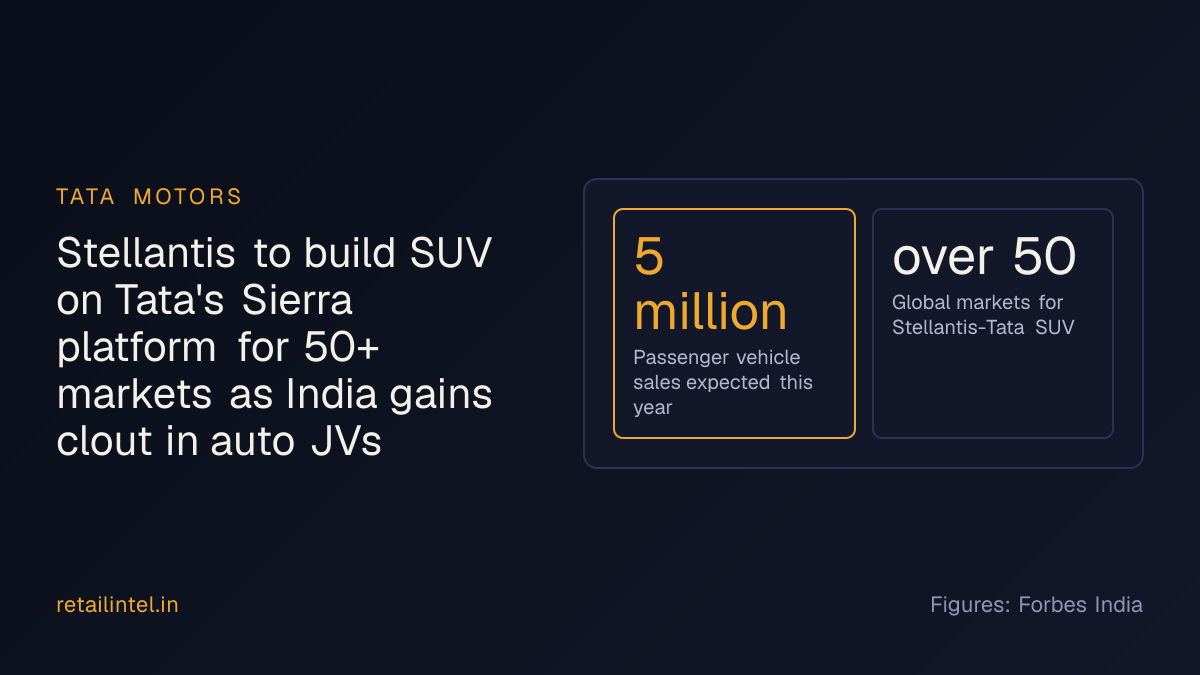
Passenger vehicle sales in India are expected to reach 5 million this year, as Stellantis plans a B-segment SUV on Tata's Sierra platform for over 50 global markets. Honda Cars has also signed with Tata Technologies for an India-specific platform.
- Passenger vehicle sales expected this year
- 5 million
- Global markets for Stellantis-Tata SUV
- over 50
One email each morning: the day’s top moves in Indian retail, why each matters and what to watch. Free. Stop any time.
Reported figures
From the report. Source details below
| Cars sold in India in 1982: | around 50,000 |
|---|---|
| Product development cycle in India: | three to five years |
| Product development cycle in China: | about 18 months |
| Mahindra Research Valley patents: | 210 |
| Mahindra Research Valley patent applications: | 1,979 |
Why it matters to operators
With Stellantis on Tata's Sierra platform and Honda Cars signing Tata Technologies, India's expected 5 million passenger vehicle sales this year shift leverage to Indian partners, so JV and platform-sharing talks should be pitched around India-origin platforms and engineering.
What to watch next
- A definitive Stellantis and Tata Motors agreement announcing licensing or supply terms
- Honda Cars and Tata Technologies naming a timeline for the India-specific platform
- Tata Motors quarterly disclosure of platform licensing or engineering revenue
- A second foreign OEM announcing a platform deal with an Indian company
Likely next moves
Our read of what comes next — analysis, not reported by the source.
- Stellantis is likely to firm up the B-segment SUV programme on the Sierra platform and name the first markets for its 50+ market plan.
- Tata Motors is likely to present platform sharing as a repeatable model and pitch the Sierra architecture to other global carmakers.
- Honda Cars is likely to deepen its India-specific platform work with Tata Technologies and move from signing to a defined development schedule.
- Other foreign carmakers may open talks with Indian firms on shared platforms, citing India's expected 5 million passenger vehicle sales.
- Tata Technologies is likely to market engineering and platform services to more overseas OEMs.
The counter-case
The case against this reading — not reported by the source.
The headline reads more like a narrative than a confirmed shift in leverage. Stellantis only 'plans' a B-segment SUV, and the deck gives no signed licensing terms, investment, volumes, launch date or list of the 50+ markets. Honda's deal is with Tata Technologies, an engineering-services arm, so it may be a paid design contract. That is not the same as a global OEM licensing Tata's platform and ceding strategic control. The simpler reading is that Stellantis and Honda are cutting development costs and using India's low-cost engineering, and that says more about their cost pressure than about Indian bargaining power. The 5 million passenger vehicle figure is a forecast for this year, not an outcome of either deal. It is also a domestic demand number that has no direct link to platform-sharing economics. Exporting to 50+ markets brings its own hurdles: homologation, emissions and safety rules, left-hand-drive versions, brand positioning, and the fact that a Sierra-derived product has yet to prove itself abroad. Partnership announcements in autos often slip, shrink or get quietly cancelled. The signal also sits oddly under 'retail-company'. It concerns OEM manufacturing and engineering, not retail, and that weakens its relevance for the desk's audience.
The source
First seen