
On this page
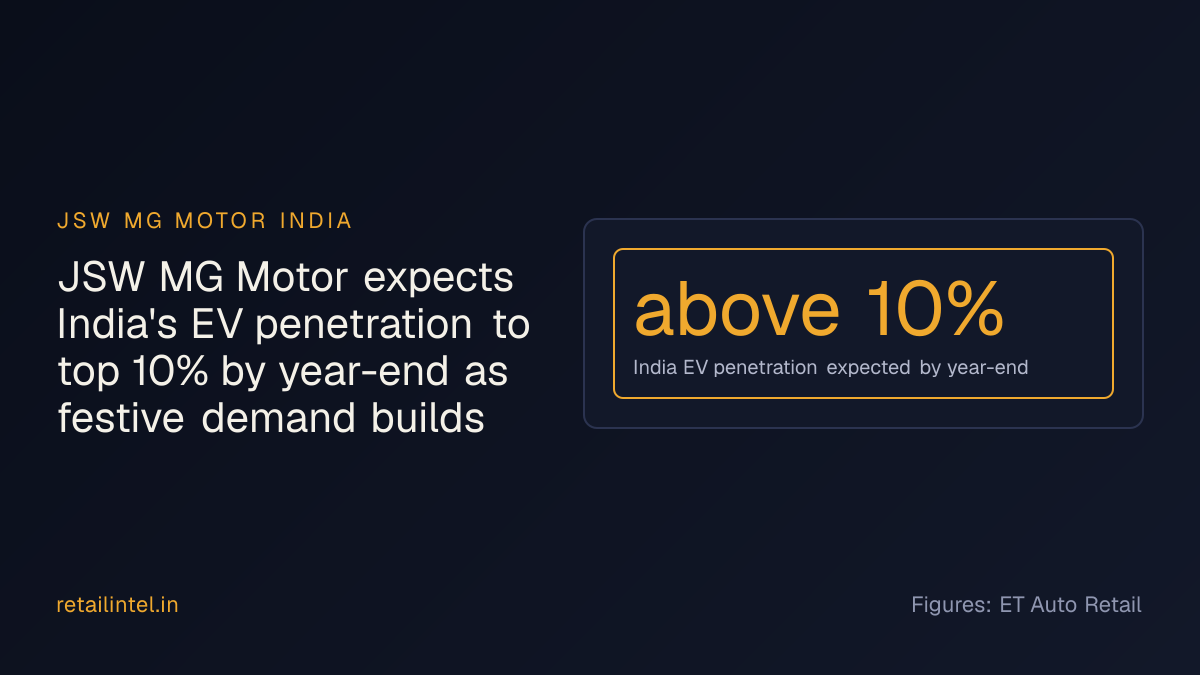
JSW MG Motor expects India's EV penetration to top 10% by year-end as festive demand builds
Our read
JSW MG Motor's festive read is more likely than not to hold, with EV penetration reaching or approaching 10% by year-end, though a narrow miss is nearly as plausible as a clear beat.
For operators
JSW MG Motor expects India's EV penetration to cross 10% by year-end, with recent EV sales nearly doubled from a year ago, so auto retailers should plan EV stock and showroom capacity for a stronger festive season.
Watch
India's EV penetration above 10% by year-end would mean festive demand held and the doubling is sticking, pushing rivals and charging operators to add capacity.
The report
JSW MG Motor says recent electric vehicle sales have nearly doubled compared with last year. The company anticipates higher demand during the festive season ahead.
- India EV penetration expected by year-end
- above 10%
One email each morning: the day’s top moves in Indian retail, why each matters and what to watch. Free. Stop any time.
What to track next
- JSW MG Motor's monthly EV sales through the festive season against the year-ago base
- Monthly EV registrations on VAHAN versus total passenger-vehicle registrations
- Waiting periods or stock shortages for JSW MG Motor's EV models at dealers
- Any change in central or state EV incentives announced before year-end
The counter-case
The case against this reading — not reported by the source.
The claim comes from an interested party, an OEM whose EV-heavy portfolio benefits from a bullish narrative, and it is a forecast, not data. 'Nearly doubled' is measured off a small base. Passenger-car EV penetration in India has recently been only in the low-to-mid single digits, so getting above 10% by year-end would need a step change in just a few months. Festive demand tends to be front-loaded and driven by discounts, so it may pull forward purchases and not signal a lasting shift. Lower GST on small ICE cars would narrow the EV price advantage during the same festive window. Other risks include supply constraints (such as rare-earth magnets and cells), thin charging infrastructure outside metros, uncertain resale values, and competition from hybrids and CNG. The 10% figure is also easy to hit by redefining the denominator, for example by including two- and three-wheelers or counting only certain segments.
The source
Filed
First seen