
On this page
Our read
Myntra is likely to extend M Now's 60–90 minute delivery as its Gen Z-heavy base keeps growing.
For operators
Myntra's orders and customers are up more than 30% this year with Gen Z now half its base, so rival fashion and beauty platforms need to match that cohort's discovery habits and the 60–90 minute store-linked delivery its M Now pilot is testing.
Watch
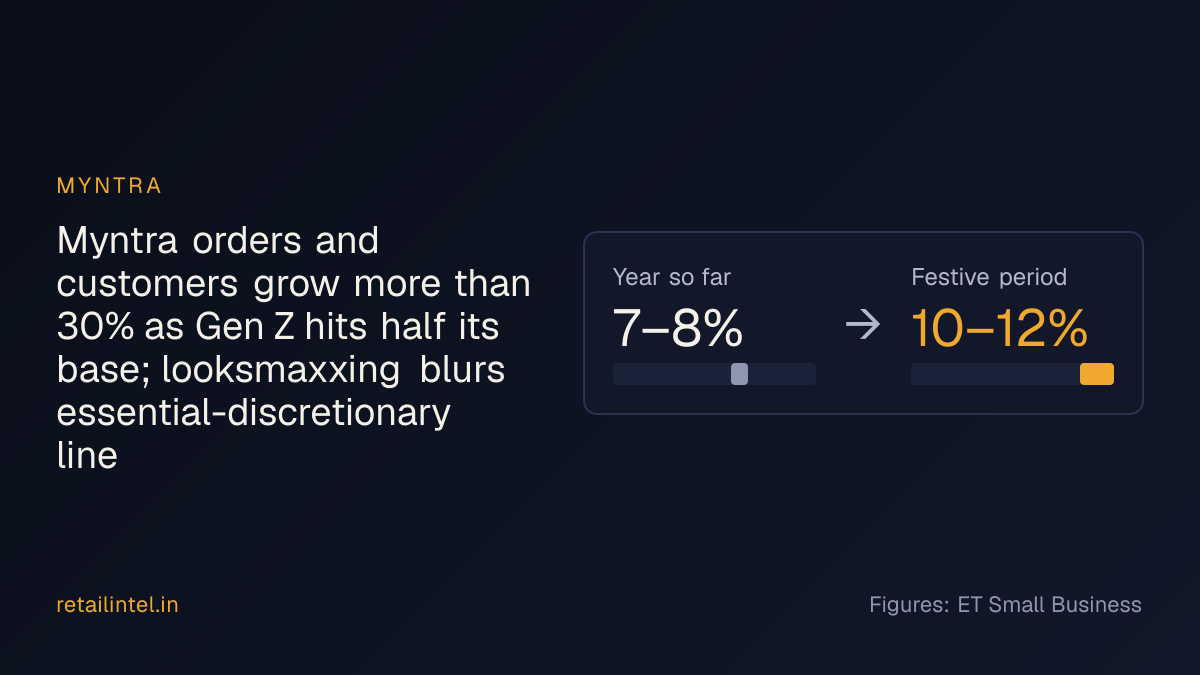
AOV growth above the 10–12% reported for the festive period, through Diwali, would mean Gen Z is trading up and brands gain pricing room over discount-led rivals.
Ask next
What else has Myntra done in the last three months?The report, : Myntra orders and customers grow more than 30% as Gen Z hits half its base; looksmaxxing blurs essential-discretionary line
Myntra's average order value rose 10–12% in the festive period, which business head Sharon Pais links to shoppers upgrading to premium products. D2C brands' share of its mix reached high double digits, and M Now piloted a store-connected model.
One email each morning: the day’s top moves in Indian retail, why each matters and what to watch. Free. Stop any time.
Reported figures
From the report. Source details below
| Average order value rise for the year so far: | 7–8% |
|---|---|
| Postal PIN codes reached: | 98% |
| Rapid delivery window in store pilot: | 60–90 minutes |
| Gen Z share of customers a few years ago: | about a quarter |
Why it matters for the brand
Myntra's M Now pilot links to stores for 60–90 minute delivery and the company says it reaches 98% of postal PIN codes, which signals that store-network and last-mile partnerships are now a route to growth in fashion e-commerce.
What to track next
- Myntra reporting festive-period order growth versus the more than 30% claimed for this year
- Any announcement widening M Now's store-linked 60–90 minute delivery
- Gen Z share of customers moving past the half reported in later disclosures
- Quick-commerce rivals widening fashion and beauty ranges in the coming quarter
Likely next moves
Our read of what comes next — analysis, not reported by the source.
- Myntra is likely to widen the M Now pilot, using store inventory for 60–90 minute delivery, if festive demand supports the economics.
- Expect Myntra to lean further into grooming, beauty and self-care assortments as looksmaxxing blurs the line between essential and discretionary spend.
- Myntra may push higher-priced and premium assortments to Gen Z shoppers while festive AOV growth of 10–12% holds.
- Quick-commerce and fashion rivals may respond with faster fashion delivery or Gen Z-targeted launches to contest Myntra's growing base.
- Brands and sellers are likely to put more inventory and marketing into Myntra, as a customer base growing over 30% raises its pull.
The counter-case
The case against this reading — not reported by the source.
Almost every figure here comes from the company itself, with no audited numbers or independent data behind it. 'More than 30%' growth in orders and customers has no stated base, period or definition. Orders and customers growing at about the same rate suggests order frequency per customer is flat, so growth is coming from acquisition, which tends to be costlier and less loyal. The 10–12% festive rise in average order value is a seasonal peak. It can reflect price inflation, gifting and heavier premium mix, not durable demand, and the 7–8% year-to-date figure is the more honest run-rate. 'Gen Z is half of customers' is a share of customer count, not of spend, and Gen Z shoppers are typically price-sensitive, discount-driven and return-prone. Fashion e-commerce returns can erase the headline order growth, and the signal says nothing about them. The 98% PIN code reach measures serviceability, not active buying, so it says little about real penetration. M Now is only a pilot, and 60–90 minute delivery is slower than the 10-minute quick-commerce standard set by Blinkit, Zepto and Swiggy Instamart, so it may not be a competitive moat. 'Looksmaxxing blurring essential and discretionary' reads as a marketing narrative, not evidence of changed purchase behaviour. Finally, there is no profitability, contribution margin or cash burn, so growth could be bought with discounts and logistics subsidies.
The source
Published
First seen