
On this page
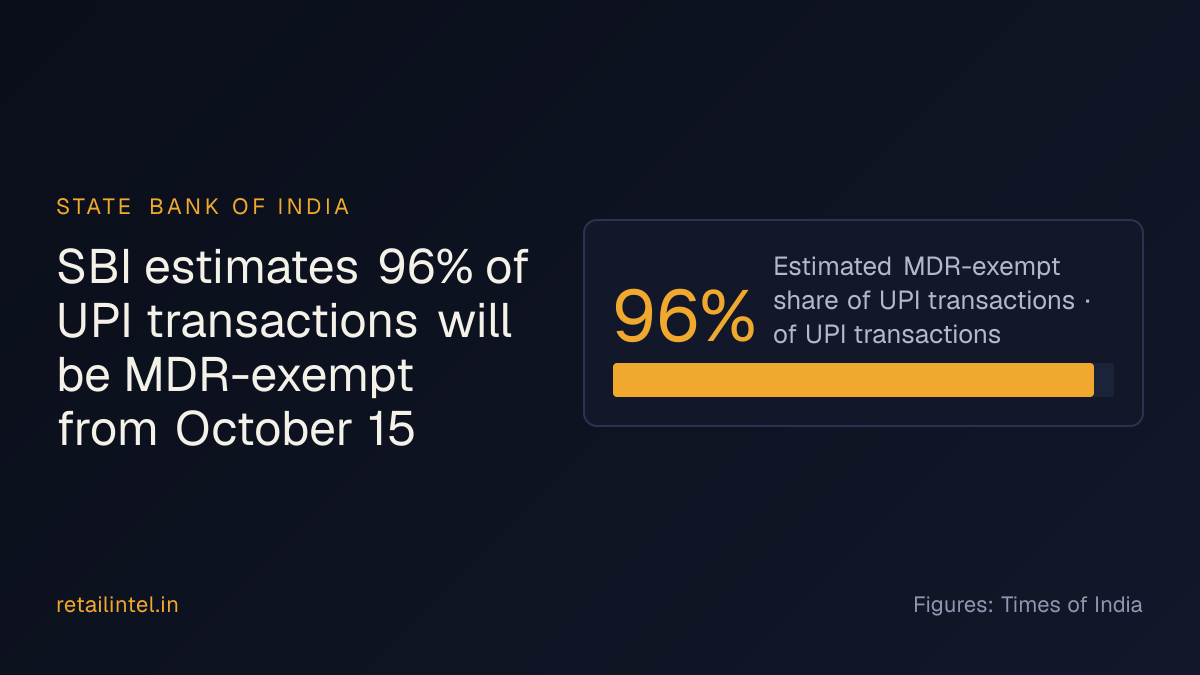
SBI estimates 96% of UPI transactions will be MDR-exempt from October 15
Our read
Broad MDR exemption is likely to preserve UPI's appeal at checkout while shifting acquiring competition toward merchant scale and pricing outside the exempt pool.
For operators
Keep UPI central to omnichannel checkout, but verify MDR exposure for payments above Rs 2,000 as SBI estimates 96% of transactions will remain exempt from October 15.
Watch
Final exemption rules and confirmation of the October 15 start
The report,
SBI estimates 96% of UPI transactions will not attract MDR when it begins on Oct 15. Banks and NPCI plan pricing controls to prevent costs reaching retail customers or small merchants, while SBI aims to expand merchant acquiring.
One email each morning: the day’s top moves in Indian retail, why each matters and what to watch. Free. Stop any time.
The counter-case
The case against this reading — not reported by the source.
A 96% exemption by transaction count could obscure substantial exposure by payment value, particularly for higher-ticket retailers. Planned pricing controls do not prove that costs will stay away from merchants or shoppers; providers could recover them through other fees or reduced service investment. Expanding SBI’s acquiring base is an ambition, not evidence of incremental retail sales.
What it means for online and offline
Explore merchant-acquiring partnerships around SBI’s planned expansion beyond its 60 lakh-merchant base, prioritizing omnichannel reach and service revenue over MDR monetization.
Signals to track
- Published bank or NPCI controls on MDR pass-through
- SBI's reported acquiring base above 60 lakh merchants
- Actual MDR-exempt transaction share versus SBI's 96% estimate
- Announced acquiring charges for non-exempt transactions
Likely next moves
Our read of what comes next — analysis, not reported by the source.
- SBI is likely to expand beyond its 60 lakh-merchant acquiring base, with broad MDR exemption reducing a potential obstacle to merchant sign-ups.
- Banks and NPCI are likely to formalise pricing controls before implementation, narrowing opportunities to pass MDR costs to shoppers or small merchants.
- SBI-acquired merchants are likely to continue promoting UPI for payments up to Rs 2,000 if the proposed exemption takes effect.
- Acquiring banks may concentrate fee-recovery efforts on non-exempt transactions, making pricing for those payments more commercially significant.
Background
Later reports that look back at earlier events in this story, newest first. They add context; nothing on this page has changed.
Resurfaced: SBI said on 15 September small merchants pay zero MDR on UPI QR receipts up to ₹1 lakh a month
On the record
Earlier State Bank of India reports on RetailIntel, newest first.
Channel facts
From the report. Source details below
| Person-to-merchant MDR exemption limit: | Rs 2,000 |
|---|---|
| SBI existing merchant acquiring base: | 60 lakh merchants |
| SBI merchant acquiring monthly volume: | approximately 13 crore monthly transactions |
| Yono current daily transaction volume: | 1-2 lakh transactions a day |
| SBI current daily UPI volume: | around 20 crore transactions daily |
Also in the report
- Yono target over next two years: five crore transactions a day
The source
Published
First seen