
On this page
Our read
Swiggy is likely to make multi-restaurant carts a standard feature that rivals copy within two quarters.
For operators
Swiggy now lets customers order from up to five restaurants in one checkout across 720-plus cities, so rival food delivery and quick-commerce operators should expect pressure to match single-payment, shared-tracking baskets, given Swiggy's finding that 55% of users build two carts in a session.
Watch
Zomato announcing a multi-restaurant cart of its own
The report, : Swiggy launches multi-restaurant ordering across 720-plus cities, with up to five restaurants in one checkout
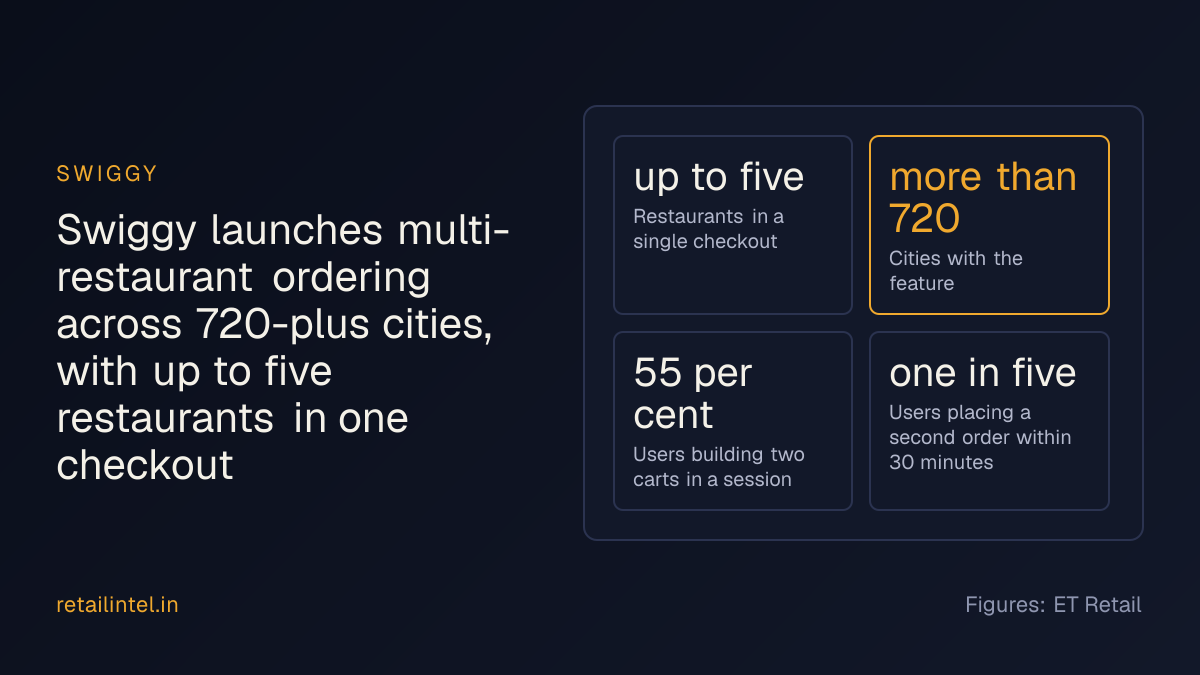
Swiggy launched a multi-restaurant ordering feature across more than 720 cities, letting customers order from up to five restaurants in one checkout with a single payment and shared tracking. Its food delivery business works with over 2.7 lakh restaurants.
- Restaurants in a single checkout
- up to five
- Cities with the feature
- more than 720
- Users building two carts in a session
- 55 per cent
- Users placing a second order within 30 minutes
- one in five
One email each morning: the day’s top moves in Indian retail, why each matters and what to watch. Free. Stop any time.
Channel facts
From the report. Source details below
| Users building two carts in a session: | 55 per cent |
|---|---|
| Users placing second order within 30 minutes: | one in five |
Signals to track
- Swiggy lifting the cap above five restaurants per checkout by the Q3 FY27 results would mean uptake is strong and rivals must match or lose multi-cart orders.
- Swiggy disclosing multi-restaurant order share or order value in its results
- Restaurant or rider complaints about delays and cold food on combined orders
- Changes to delivery fees or limits for multi-restaurant orders
Likely next moves
Our read of what comes next — analysis, not reported by the source.
- Swiggy is likely to promote multi-restaurant checkout through app placement and offers, targeting users who already build two carts in a session.
- Zomato may ship a comparable multi-restaurant cart, since the split-cart behaviour Swiggy cites is not unique to its app.
- Swiggy is likely to tune delivery fees and batching rules for combined orders, as one rider collecting from several kitchens changes the cost per order.
- Restaurant partners are likely to push for clearer prep-time coordination and sales attribution when their food travels in a shared order.
- Swiggy may cite multi-restaurant order share and basket values in its coming results commentary, to show the launch is lifting spend per session.
The counter-case
The case against this reading — not reported by the source.
This looks like a convenience tweak, not a structural shift. The case for it rests on Swiggy's own behavioural stats: 55% of users build two carts in a session, and one in five place a second order within 30 minutes. Those numbers show people browse several restaurants and sometimes reorder. They do not show that customers want one combined checkout. Combining orders could also hurt unit economics. If two separate orders (two delivery fees, two sets of platform charges) become one payment, Swiggy may earn less per basket than it does from the second orders it already gets. Operationally, pulling food from up to five kitchens into one delivery raises the risk of delays, cold food and missing items. That would damage repeat use. The rollout across 720-plus cities is broad, but breadth of availability says nothing about adoption. This is a feature launch, so the omni-channel framing is generous.