
On this page
Entry-level car sales jump 81% in April-September as Maruti Suzuki lifts Alto and S-Presso output after GST cuts
Our read
Maruti Suzuki will more likely than not keep Alto and S-Presso volumes growing faster than the wider passenger vehicle market through the rest of FY27, though entry-level share stays small.
For operators
Maruti Suzuki raised Alto and S-Presso output 38.6% as their domestic sales grew 86.3%, so dealers selling these two models are working with a much larger supply than a year earlier in a segment that is still only 3% of dispatches.
Watch
Entry-level share of dispatches above the 3% reported for April-September, in the Q3 FY27 data, would mean GST-led demand is lasting and Maruti's small-car volumes will hold.
The report,
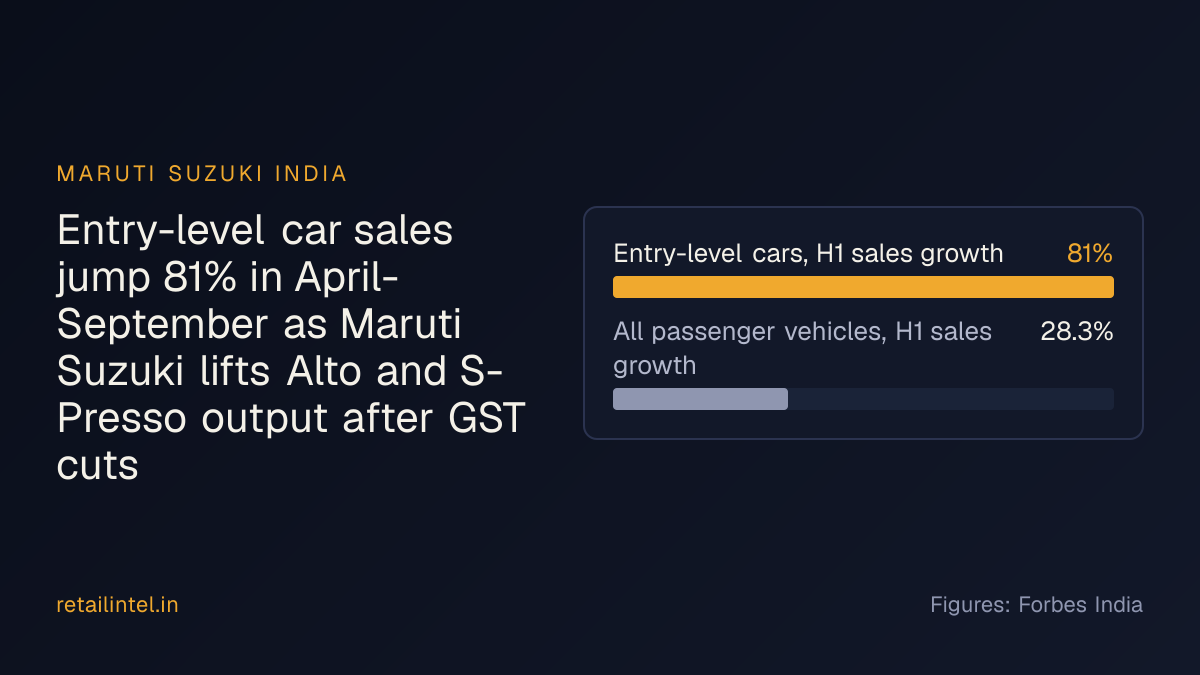
Entry-level car sales rose 81% in April-September to 77,990 units, against 28.3% growth for all passenger vehicles, as Maruti Suzuki raised Alto and S-Presso output 38.6% after the GST cuts. Maruti says first-time buyers' share rose 10%.
- Entry-level cars, H1 sales growth81%
- All passenger vehicles, H1 sales growth28.3%
One email each morning: the day’s top moves in Indian retail, why each matters and what to watch. Free. Stop any time.
Reported figures
From the report. Source details below
| Alto and S-Presso domestic sales growth: | 86.3% |
|---|
Why it matters for the brand
Entry-level dispatches rose 81% to 77,990 units in April-September against 28.3% for all passenger vehicles, but the segment is still only 3% of dispatches, so the growth comes off a small share of the market.
What to track next
- Alto and S-Presso domestic sales growth against the 86.3% reported for April-September
- Monthly entry-level dispatches in industry data for October and November
- Entry-priced launches or price cuts from Hyundai, Tata or Renault
The counter-case
The case against this reading — not reported by the source.
The 81% figure is a rate on a very small, depressed base, so it overstates what happened. 77,990 units over six months is only about 3% of passenger vehicle dispatches, so the segment is still marginal. The comparison period was most likely before the GST cut took effect, when entry-level demand was at a cyclical low. If so, most of the jump is a one-off price-elasticity rebound that will fade once the base normalises. The data also measure dispatches (factory-to-dealer wholesale), not retail registrations. Dispatches can run ahead of real customer demand if Maruti is restocking dealers after the tax change. The headline says 'sales' while the deck says 'dispatches', which blurs this. The gap between Maruti's 38.6% output increase and its 86.3% domestic sales growth for Alto and S-Presso is also ambiguous. It could mean inventory drawdown, capacity limits or timing, and it does not clearly show confident, sustained demand. Overall passenger vehicles grew 28.3%, so part of the entry-level surge is a market-wide tax effect, not a specific revival of small cars. The segment's long-run shift toward SUVs and higher-priced models is not reversed by one half-year.
The source
First seen