
On this page
Maharashtra FDA's loose-spice crackdown threatens small MMR retailers and women's self-help groups
Our read
Maharashtra FDA will more likely than not keep the spice drive going but add a compliance route for small sellers and self-help groups, so loose spices lose some share without disappearing.
For operators
Maharashtra FDA's ongoing drive against loose spices, estimated at 10% to 15% of MMR retail sales, puts that revenue line at risk for small retailers, who should review sourcing and compliance and weigh packed alternatives.
Watch
Share of spice samples failing FDA tests in MMR
The report,
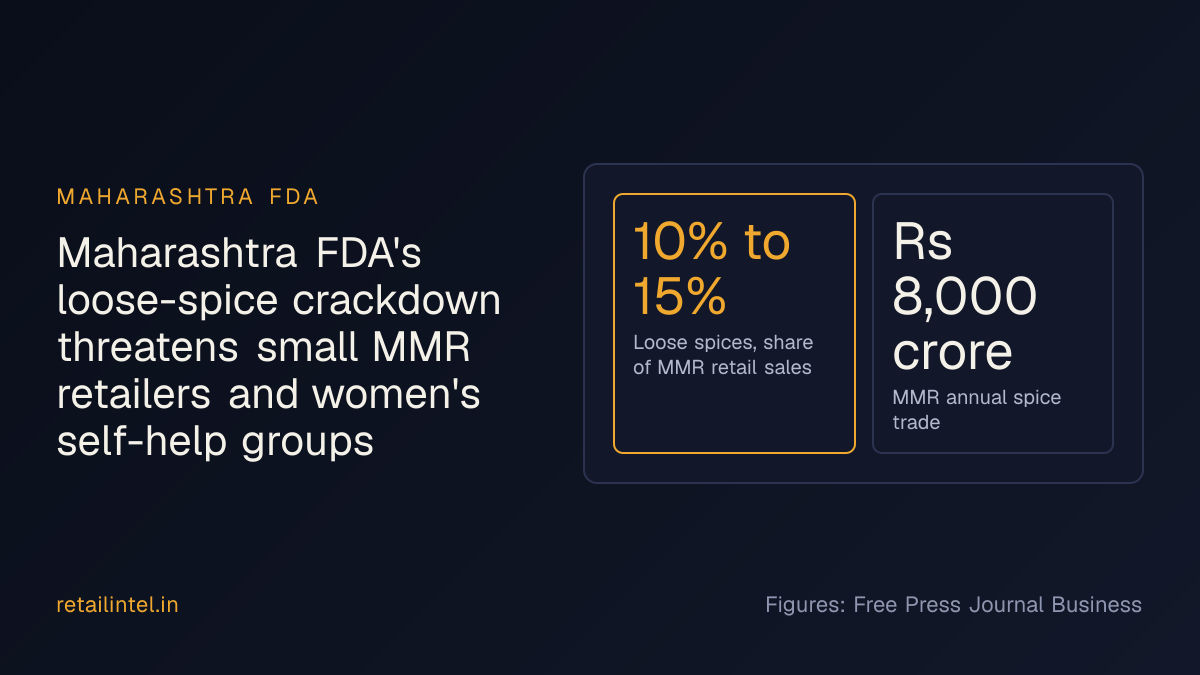
Loose spices, which Maharashtra FDA is targeting, account for an estimated 10% to 15% of retail sales in the Mumbai Metropolitan Region, where the annual spice trade is around Rs 8,000 crore. Wholesalers at APMC Vashi expect little disruption.
- Loose spices, share of MMR retail sales
- 10% to 15%
- MMR annual spice trade
- Rs 8,000 crore
One email each morning: the day’s top moves in Indian retail, why each matters and what to watch. Free. Stop any time.
Why it matters to operators
The FDA crackdown hits loose spices, estimated at 10% to 15% of MMR retail sales within a Rs 8,000 crore annual spice trade, so the near-term pressure falls on informal sellers while APMC Vashi wholesalers expect little disruption.
What to watch next
- State or FDA announcement of registration camps or relief for self-help groups
- Retailer association petitions, protests or court challenges over seizures
- Packaged spice sales growth in MMR in the next quarterly results
Likely next moves
Our read of what comes next — analysis, not reported by the source.
- Maharashtra FDA is likely to keep sampling and issuing notices to loose-spice sellers in MMR, focusing on adulteration, licensing and labelling rather than a ban on loose sales.
The counter-case
The case against this reading — not reported by the source.
The headline claims a threat, but the evidence shows only an exposure. The 10% to 15% loose-spice share is a market-size estimate. It does not measure how much sales or how many jobs the drive actually puts at risk. Enforcement of existing food-safety rules on licensing, labelling and adulteration is not a ban on loose sales. Most compliant small sellers could keep trading after a registration, a basic hygiene upgrade or a switch to sourcing from licensed suppliers. The one hard market signal points the other way: APMC Vashi wholesalers expect little disruption, so upstream supply and volumes look intact. FDA drives in India are often episodic, concentrated on a few adulteration cases, and fade after a few weeks. The 'women's self-help groups' angle looks anecdotal, with no count of affected groups or any sign they are targeted. The Rs 8,000 crore figure is a trade total, so it may mix wholesale, branded and export-linked flows and overstate what is exposed at retail. If anything, tighter enforcement would favour branded and packaged spice makers and compliant retailers, so this may be a share shift rather than a retail-wide loss. At worst, the signal is a short-lived compliance cost story with a dramatic framing.
The source
Published
First seen