
On this page
Our read
Swiggy is likely to lean on budget formats like Toing to keep its small-town push going.
For operators
Swiggy is adding 10 to 20 cities every quarter, runs in more than 700 towns and onboards about 30,000 delivery partners a week, so rival delivery platforms and restaurant chains need to match its small-town reach and rider supply.
Watch
Weekly delivery-partner onboarding against the 30,000 reported
Ask next
What else has Swiggy done in the last three months?The report, : Swiggy adds 10 to 20 cities every quarter, eyeing the 90% of Indians yet to try food delivery
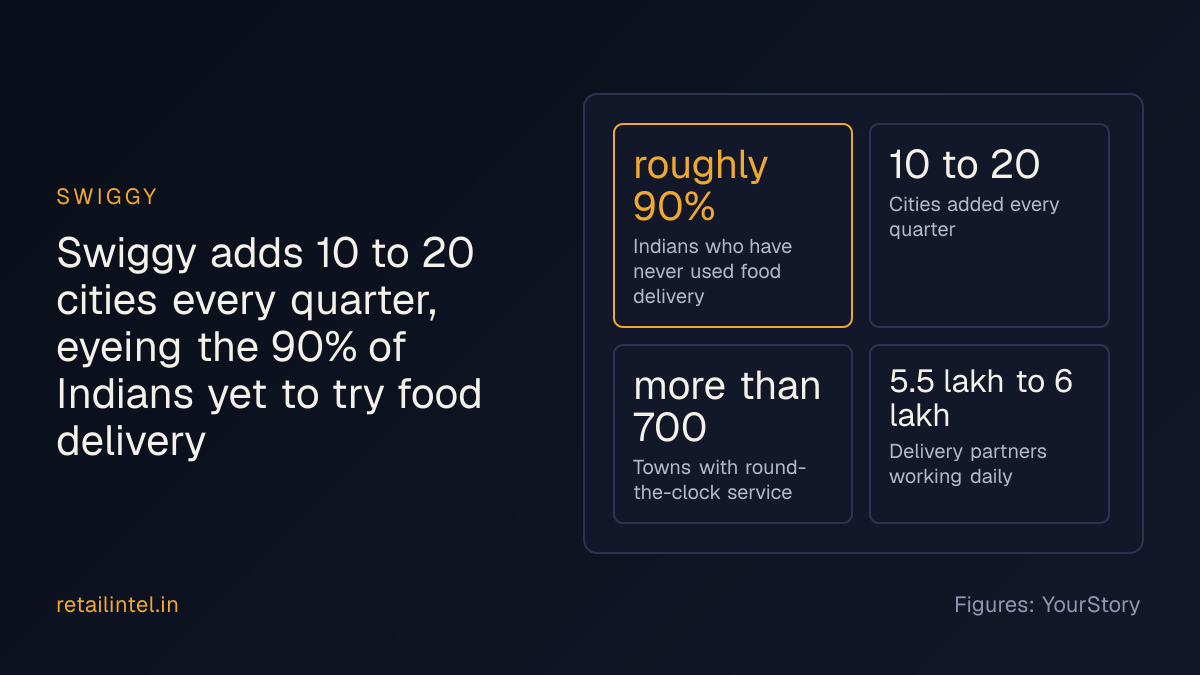
Swiggy adds 10 to 20 cities every quarter and runs round the clock in more than 700 towns, Food Marketplace CEO Rohit Kapoor said at TechSparks 2026. He said roughly 90% of Indians have never used food delivery and pointed to budget app Toing.
- Indians who have never used food delivery
- roughly 90%
- Cities added every quarter
- 10 to 20
- Towns with round-the-clock service
- more than 700
- Delivery partners working daily
- 5.5 lakh to 6 lakh
One email each morning: the day’s top moves in Indian retail, why each matters and what to watch. Free. Stop any time.
Reported figures
From the report. Source details below
| Delivery partners onboarded each week: | approximately 30,000 |
|---|---|
| Delivery partners working daily: | 5.5 lakh to 6 lakh |
| AI projects under way: | around 200 |
Why it matters to operators and investors
Swiggy's push into 700-plus towns with 5.5 lakh to 6 lakh delivery partners working daily and around 200 AI projects under way suggests demand for small-town supply, rider-ops and AI tooling partners, while Toing is a low-price segment to watch.
What to watch next
- Towns served above the 700 reported, by the Q3 FY27 results, would mean the 10 to 20 cities a quarter pace holds and rivals must defend smaller markets sooner.
- Disclosure of Toing order volumes or user numbers in the next results
- Zomato or Zepto announcing launches in the same small towns
- Gig-worker social security rules or state laws that raise platform costs
Likely next moves
Our read of what comes next — analysis, not reported by the source.
- Swiggy is likely to keep launching in 10 to 20 new cities each quarter, favouring towns where its delivery-partner pool is already forming.
- Swiggy may widen Toing, its budget app, to more towns and test how far low-ticket orders can lift frequency among first-time users.
- Rivals such as Eternal's Zomato and Zepto are likely to answer in the same smaller markets, with local offers and wider restaurant coverage.
- Expect Swiggy to roll out more of its roughly 200 AI projects in delivery-partner allocation and city operations, to hold costs down as it expands.
- State and central labour regulators may press platforms harder on gig-worker benefits as Swiggy's daily rider base of 5.5 lakh to 6 lakh grows.
The counter-case
The case against this reading — not reported by the source.
The headline reads as a management talking point, not evidence of economic progress. 'Adding 10 to 20 cities a quarter' counts the number of places Swiggy is live, not orders, revenue or profit. New small towns usually have low order density, smaller baskets, long delivery distances and thin restaurant supply. Each of these hurts unit economics, so growth there is likely to be margin-dilutive for a long time. The '90% of Indians yet to try food delivery' figure is a total-market estimate. It says nothing about how many of those people can afford the service, will use it repeatedly, or will stay once launch discounts end. Launching the budget app Toing suggests Swiggy needs a cheaper, lower-take-rate offer to reach these users, which points to price pressure rather than easy monetisation. The labour numbers also cut both ways. Onboarding about 30,000 delivery partners a week against 5.5 lakh to 6 lakh working daily implies heavy churn, or heavy subsidised recruitment, and carries regulatory risk as gig-worker social-security rules tighten. '200 AI projects' is an activity count, not an outcome. Rivals, including the Eternal-owned Zomato and quick-commerce players, can match small-town launches, which would erode any first-mover advantage.
The source
First seen