
On this page
Urban Company board clears raise of up to ₹2,500 Cr as September-quarter net loss hits ₹182.5 Cr
Our read
Urban Company will more likely than not raise in stages and keep InstaHelp funded, with losses narrowing only gradually ahead of its Q3 FY28 breakeven target.
For operators
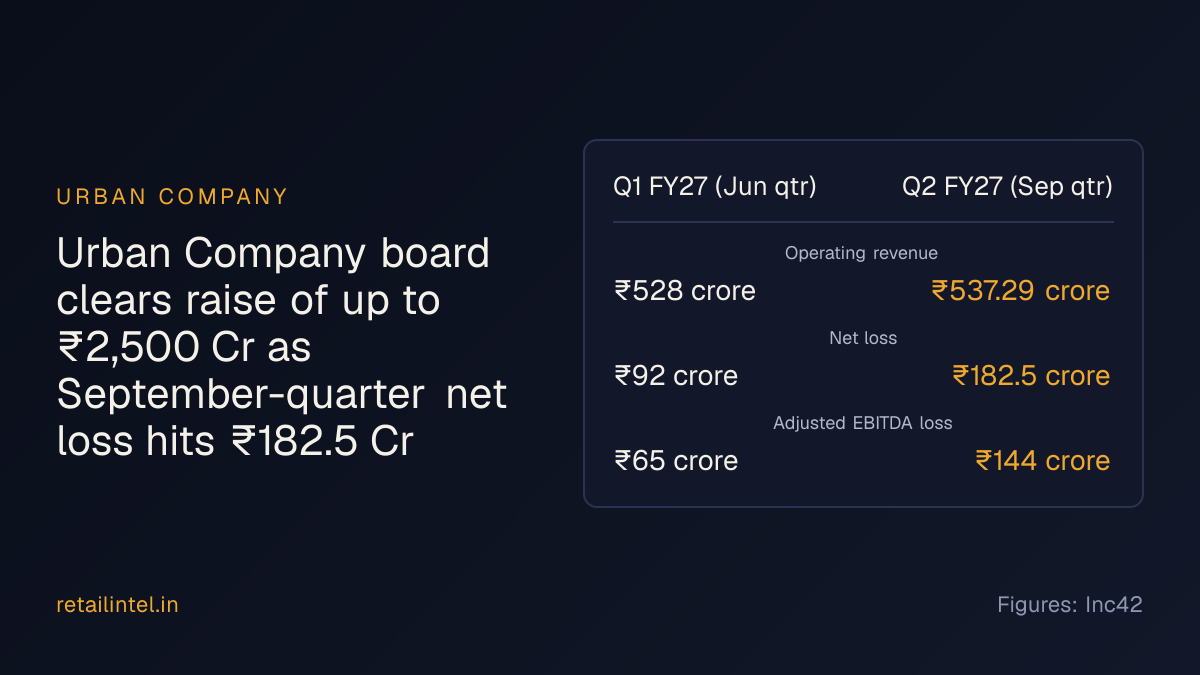
Urban Company posted a ₹182.5 Cr September-quarter net loss on ₹537.29 Cr revenue (+41%) and has board approval to raise up to ₹2,500 Cr, so home-services rivals face a competitor targeting breakeven by Q3 FY28.
Watch
Shareholder vote on the ₹2,500 Cr enabling resolution and its margin of approval
The report,
Urban Company's board approved raising up to ₹2,500 Cr via equity, warrants, convertible debentures or preference shares, subject to shareholder approval. September quarter net loss more than tripled YoY to ₹182.5 Cr on operating revenue of ₹537.29 Cr.
One email each morning: the day’s top moves in Indian retail, why each matters and what to watch. Free. Stop any time.
Reported figures
From the report. Source details below
| Operating revenue growth YoY: | 41% |
|---|---|
| Adjusted EBITDA loss for the quarter: | ₹144 Cr |
Why it matters to operators
Urban Company's board cleared a raise of up to ₹2,500 Cr via equity, warrants, convertible debentures or preference shares, so shareholders will vote on it while the company targets breakeven only by Q3 FY28.
What to watch next
- Instrument mix disclosed: equity versus warrants, convertibles or preference shares
- Operating revenue growth against the 41% reported for the September quarter
- Adjusted EBITDA loss below the ₹144 Cr reported for the September quarter, in the Q3 FY27 results, would mean InstaHelp spend is peaking and the raise is a cushion.
- Funding rounds or discount pushes announced by quick-service home-help rivals
The counter-case
The case against this reading — not reported by the source.
The headline treats a fundraise as a sign of strength, but it points to a cash problem. A company that has only recently listed is asking for up to ₹2,500 Cr, while its net loss of ₹182.5 Cr more than tripled on 41% revenue growth (₹537.29 Cr). That is negative operating leverage: each extra rupee of revenue is coming with a larger loss. The ₹174 Cr put into InstaHelp is bigger than the whole ₹144 Cr adjusted EBITDA loss. The quick-service bet is therefore consuming more than the company's entire reported burn, and its unit economics are unproven. The menu of instruments (equity, warrants, convertible debentures, preference shares) suggests management wants maximum flexibility rather than a defined need. Any of these would dilute shareholders or add future claims on the company. A breakeven target of Q3 FY28 is roughly two years out, and such dates usually slip when a company is competing for market share against well-funded rivals. The FY31 ₹1,000 Cr target is distant and unspecified.
The source
First seen