
On this page
Swiggy’s food delivery stays profitable as Instamart loss widens to ₹778 Cr
Our read
Swiggy’s food-delivery profit will increasingly be treated as funding for Instamart’s scale race; investor sentiment will hinge on evidence that quick-commerce loss growth peaks before competitive expansion does.
For operators
Swiggy’s profitable food-delivery engine is funding Instamart’s rapid expansion, making tighter fulfillment economics and disciplined spend critical to narrowing the ₹778 Cr adjusted EBITDA loss.
Watch
Instamart adjusted EBITDA loss trend relative to GOV growth over the next two quarters.
The report,
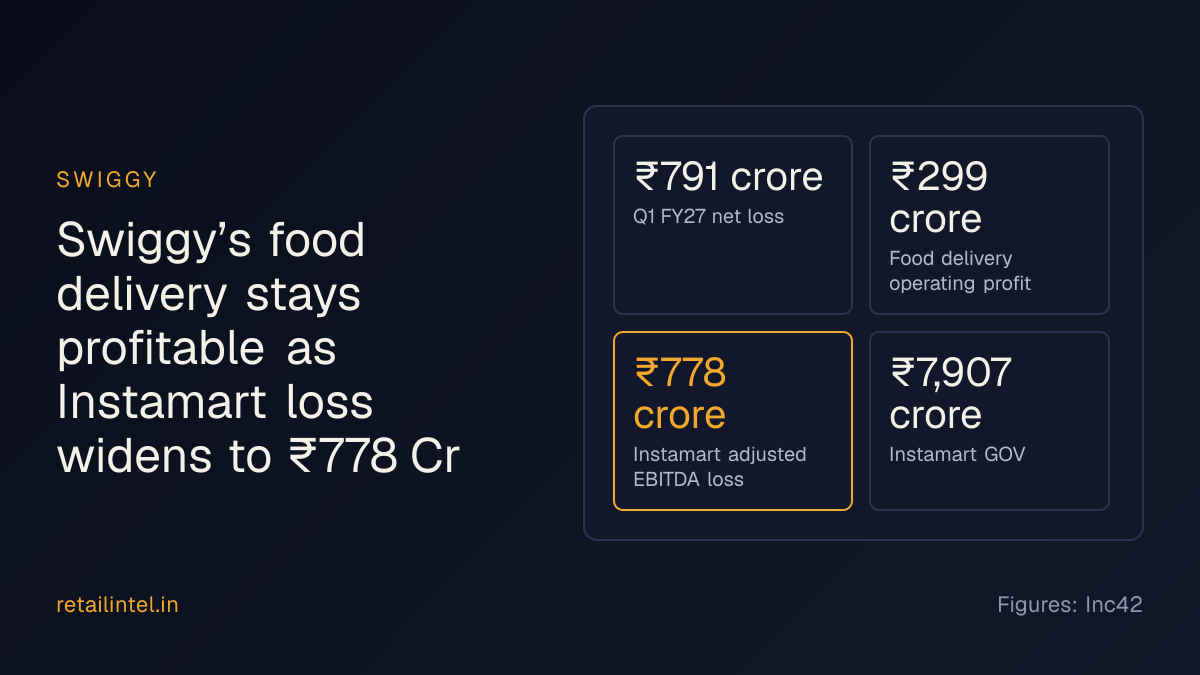
Swiggy reported a ₹791 Cr loss in Q1 FY27, as Instamart’s adjusted EBITDA loss reached ₹778 Cr despite ₹7,907 Cr GOV; food delivery generated ₹2,208 Cr operating revenue and ₹299 Cr operating profit.
- Q1 FY27 net loss
- ₹791 crore
- Food delivery operating profit
- ₹299 crore
- Instamart adjusted EBITDA loss
- ₹778 crore
- Instamart GOV
- ₹7,907 crore
One email each morning: the day’s top moves in Indian retail, why each matters and what to watch. Free. Stop any time.
Reported figures
From the report. Source details below
- 15%
- ₹500
- 17.4%
- 70-basis-point
Why it matters to operators
Swiggy’s widening Instamart losses raise the strategic value of partnerships, supply-chain assets, and consolidation opportunities that can add scale while lowering customer-acquisition and delivery costs.
What to watch next
- Contribution margin and mature dark-store profitability disclosures.
- Dark-store count growth, new-city launches and capex/lease commitments.
- Customer acquisition, discounting and delivery-cost trends at Blinkit and Zepto.
- Advertising revenue mix, average order value, order frequency and basket-margin improvement.
- Consolidated cash burn, free-cash-flow trajectory and any need for additional capital.
Likely next moves
Our read of what comes next — analysis, not reported by the source.
- Moderate Instamart dark-store additions toward high-density neighborhoods and cities with proven repeat behavior.
- Increase monetization through sponsored listings, brand-funded promotions, subscription benefits and higher-margin private-label assortment.
- Tighten customer-acquisition spending and shift promotions toward retention, baskets, and frequency rather than headline GOV.
- Use food-delivery profitability to protect consolidated liquidity while setting clearer loss-per-order and store-payback guardrails.
- Rationalize underperforming fulfillment locations if mature-store contribution does not improve.
The counter-case
The case against this reading — not reported by the source.
Instamart’s ₹7,907 Cr GOV is not yet proving economic viability: a ₹778 Cr adjusted EBITDA loss implies that growth is being purchased through dark-store expansion, discounts, logistics and customer acquisition. Food delivery’s ₹299 Cr operating profit is insufficient to offset this burn, leaving Swiggy dependent on continued capital and exposing it to a damaging choice between slowing growth or sustaining losses.
The source
First seen